Parks & Recreation
Click on one of the links below for
more information about Hanover Parks & Recreation.
About the Parks &
Recreation Committee
Parks & Recreation
Staff / Contact Us
Benefits of Recreation
Downloads
Related Links
Bandstand Concerts
Hanover Parks and Rec Website
HanoverParks AndRecreation

Create Your Badge
About the Parks & Recreation
Committee
Background
The Hanover Park and Recreation Committee is a six member appointed Board which
was first established as the Playground Committee at the March 1930 Annual Town
Meeting, and reestablished under the provisions of Massachusetts General Laws
(M.G.L.) Chapter 45, Section 14. For Additional Information see Section
4-18 of the Town of Hanover General Bylaws.
History of the Hanover Park and Recreation Committee
Click here to download a History of the Hanover Park and Recreation Committee
Purpose
"Recreation's purpose is not to kill time, but to make life, not to keep a
person occupied, but to keep them refreshed; not to offer an escape from life,
but to provide a discovery of life." (Author Unknown)
Current Park & Recreation Committee
Members
Click here to view or download the current Park and Recreation Committee
membership with committee designations, addresses, and terms of service.
Members of the Park & Recreation Committee*
 |
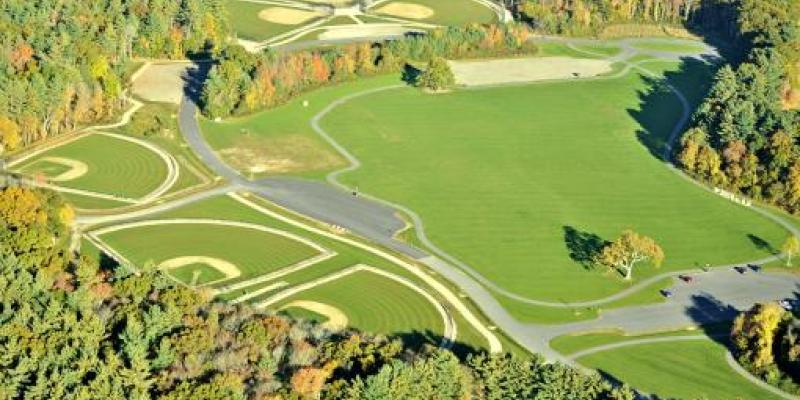
King Street Recreational Fields Construction Schedule |
(*Formerly the Playground Committee) (Current & Former)
PeEdmund Q. Sylvester (1930)
Stanley A. Briggs (1930)
William A. Flynn (1930)
George L. Legg (1947-51)
Alfred G. Lovell (1947-61)
William W. Lloyd (1947-60)
Calvin J. Ellis (1951)
Edward F. Schofield (1952-56)
Austin E. Briggs (1956-58)
Harry E. Gerrish (1959-66)
Kenneth R. Lingley (1960-65)
Paul Demers (1965-73)
John L. Merrick (1966-73)
(1967 Playground Committee extended to six members.)
Preston A. Landers (1967-68)
William L. Cicchese (1967-69)
John D. MacBain, Jr. (1967-73, 1978-79)
Robert J. Boyle (1969-73)
Richard J. Collins (1969-74)
(1971 Playground Committee became Park and Recreation Committee.)
John W. MacDougall, Jr. (1973-76)
Harold S. Smith (1973-75)
Paul P. Basiliere (1973-74)
Diana Morris (1974-78)
Gene G. Macomber (1974-78)
George Ronald Babineau (1974-78, 1980-82)
Ronald K. Whitt (1976-79)
Audrey Yeingst (1976-80)
Michael A. O’Malley (1976-88)
Judith A. Brooks (1978-83)
Patricia Beers (1978-80)
Ernest MacFadgen (1978-81)
Robert J. Flynn (1980-81)
Mary Miele (1980-82)
Thomas J. Scannell (1981-88)
Peter D. McIntyre (1982-84)
Donald F. Buckley (1982-88)
Darrell Brandon (1984-88)
James DiGravio (1987-89)
Arthur Ceurvels, Jr. (1988-06)
Ralph Lordi (1988-90)
John L. Gabriel, Jr. (1988-06)
Robert Shea (1988-89)
Sydney E. Elliott, III (1988-92)
Barbara J. Stone (1989-91)
Patricia Shea (1989-98) (Also Bandstand Committee Representative)
Mark Harrington (1990-99)
Kathleen A. Flanagan (1992-07)
Christine Keegan (1992-02)
Linda DiNardo (1998-07) (Also Bandstand Committee Representative)
Douglas J. McLaughlin (1999-05)
Stephen J. Carroll (2002-08)
Cathy Harder-Bernier (2005-present)
Mike Tivnan 2005-Present
Amy Perkins 2005- Present
Julianne McLaughlin 2005-Present
Peter Beauchamp 2008-2009
April Maneupelli 2008-Present
John Balzarini 2009-Present
Harry Dunn 2009-Present
Parks & Recreation Staff / Contact
Us
Recreation Administrator: Lauren Devine
Phone: 781-878-6361
Phone: 781-826-7529 (PLAY) for Summer Program
Fax: 781-826-5950
Address:
Hanover Park and Recreation Committee
550 Hanover Street
Hanover, MA 02339
Benefits of Recreation*
(*From "The Benefits
Catalogue," Canada)
1) Recreation and active living are important to personal health:
Recreation and active living helps people live longer – adding up to two years
to life expectancy.
Recreation, fitness, sports, and active living significantly reduces the risk
of coronary heart disease and stroke – the leading cause of death in United
States.
Recreation, fitness, sports, and active living combats diabetes – the fourth
ranking killer disease (after heart disease, cancer, and respiratory disease).
Recreation, fitness, sports, and active living has been shown to help in
preventing site specific cancers – particularly in the colon, breast and lungs.
Recreation, fitness, sports, active living, parks and arts/culture all
contribute to mental health – reducing stress, reducing depression, and
contributing to emotional/psychological well-being.
Recreation is important to balanced human development – helping people reach
their potential.
Recreation is essential to the development of our children and youth: We learn
motor skills (physical) through play and sports. We learn social skills through
play and sports. We learn creativity through play and arts/cultural activity.
We develop intellectual capacities and concepts through play – and many other
life skills.
Recreation and parks are important to quality of life.
Recreation, sports, and arts/culture build self-esteem and positive self-image –
foundations to personal quality of life.
Recreation, parks, sports, and arts/culture enhance perceived quality of life –
for individuals, families, and communities.
Recreation, sports, and arts/culture reduce self-destructive behaviour and
negative social activity in youth – an antidote to smoking, substance abuse,
suicide, and depression.
2) Recreation and parks build stronger families and healthier
communities:
Families that play together – stay together. Children and youth remain
connected; couples that share leisure interests are more likely to stay
together.
Recreation, sports, and arts/culture produce leaders who serve their communities
in many ways.
Recreation, sports, and arts/culture build social skills and stimulates
participation in community life.
Recreation and parks are often the catalysts that build strong, self-sufficient
communities (sports groups, arts guilds, adopt-a-park).
Recreation, parks, sports, and arts/culture build pride in a community.
3) Recreation and parks are significant economic generators.
Recreation, sports, and fitness improves work performance – increased
productivity, decreased absenteeism, decreased staff turnover, reduced ‘on the
job’ accidents.
Recreation, parks, and arts/culture attract businesses to the community – prime
economic development and relocation magnets.
Parks and open spaces increase property value, and therefore tax revenue, on
adjacent land – many developers are automatically including parkland, golf
courses, etc. as marketing features.
Downloads
Click on the links
below to see Parks & Recreation related Downloads:
Bylaws &
Regulations
Maps & GIS
Forms,
Permits &
Applications
Related Links
Town of Hanover Website
Hanover Bandstand Committee
Hanover Youth Athletic
Association
Hanover Youth Hockey
Association
Hanover Public Schools
Hanover High
School Athletics Calendar
John Curtis Library
Massachusetts Recreation and Park
Association
Massachusetts State Website
National Recreation and Park Association
South Shore Moms and Dads Guide
Hanover Mariner |